Key Takeaways
- Book your moving day on a weekday if possible. Saturdays at Casselberry apartment complexes are chaotic, and you’ll compete for elevator time and loading zones with two or three other households.
- Most Casselberry complexes require a certificate of insurance (COI) from your moving company before they’ll release the freight elevator. Request it at least 5 business days before your move date.
- A targeted box kit beats buying in bulk. First-time renters consistently over-buy large boxes and end up with towers of empty cardboard taking up half the new unit.
- Do your move-in inspection before a single box comes through the door. Photos with timestamps protect your deposit on move-out day.
Renting your first apartment in Casselberry is exciting. You’re close to SR-436 Semoran, a short drive from Altamonte Mall and Cranes Roost Park, and you’ve got that mix of quiet neighborhood feel with quick highway access to I-4. But the actual move? That part can unravel fast if you haven’t dealt with apartment-specific logistics before.
When moving day arrives, our Casselberry movers are ready to do the heavy lifting.
A house move and an apartment move are two completely different animals. Parking restrictions, elevator reservations, narrow hallways, COI requirements from management offices, and move-in inspection forms all show up at once. Miss any one of them and your moving day gets expensive or delayed.
This checklist is built specifically for first-time renters doing a Casselberry apartment moving job. We’ll go section by section through every piece you need to handle before the truck arrives, while it’s there, and the moment you walk through the door for the first time as a tenant.

Picking Your Moving Day
The day you choose matters more than most first-timers expect. Here’s the short version: avoid Saturdays in May, June, and August. Those are the peak apartment turnover windows in Central Florida. Leases in the area almost universally end on the last day of the month, so the first Saturday of June is essentially a communal moving day for half of Casselberry and Winter Springs.
On a busy Saturday, you’re looking at a shared loading dock or limited parking zone with multiple move-out and move-in crews overlapping. Some complexes enforce strict 2-hour elevator reservation blocks, and if the crew ahead of you runs long, yours waits. That wait costs you money if you’re paying hourly movers.
My honest recommendation: book a Tuesday or Wednesday. You’ll almost always get a same-day elevator block, parking is wide open, and movers typically run 15 to 20 percent faster because there’s no congestion around the building. For a standard 1-bedroom Casselberry apartment move, that’s the difference between a 3-hour job and a 4.5-hour job. At $120 to $150 per hour for a two-person crew, that’s real money.
One more thing on timing. Florida’s afternoon thunderstorm season runs June through September. If you must move in summer, schedule your start time for 7 or 8 AM. By 2 PM, SR-436 and 17-92 are dealing with flash flooding and reduced visibility. Wet cardboard boxes collapse. And the humidity alone will warp anything made of particle board if it sits on a truck for an extra hour while a storm passes. For more on handling Florida weather on moving day, see our full breakdown of what happens when rain strikes your Orlando move.
Elevator Reservations and Certificate of Insurance
This is the step that catches first-timers off guard more than any other. Most multi-story Casselberry apartment communities require two things from you before move-in day: a confirmed elevator reservation and a COI from your moving company naming the property management as an additional insured.
Here’s the process:
- Call or email your leasing office at least 7 days out and ask specifically: (a) do you require a COI from my moving company, (b) what dollar amounts do you need on that COI, and (c) how do I reserve the freight elevator or loading area?
- Get the exact COI requirements in writing. Most complexes in the Casselberry and Altamonte Springs area ask for $1,000,000 general liability. Some ask for $100,000 property damage coverage separately. If your mover can’t produce that certificate, the building manager can legally turn the truck away.
- Confirm the elevator reservation 48 hours before your move. Things change. The person who took your reservation may not have logged it correctly. A quick confirmation call takes 3 minutes and can save your entire move date.
I had a customer in the Sterling Park area of Casselberry last spring who hired a smaller moving operation to save a few dollars. Move morning, the building manager asked for the COI. The movers didn’t carry one. The building wouldn’t let them past the lobby. She called us at 8:30 AM in a panic. We dispatched a two-person crew by 10 AM with the COI already emailed to the property, and we still finished her one-bedroom move by 1 PM. The total bill was $480. The original quote she was trying to save money on was $310. Not a trade-off worth making.
And don’t forget to ask about padding and runner requirements. Some complexes require movers to lay floor runners in common hallways and pad the elevator interior. We carry all of that as standard, but a day-labor operation may not.
Parking Permits at Common Casselberry Complexes
Casselberry sits in a mix of Seminole County and Orange County jurisdictions depending on the exact address, and parking enforcement varies by complex and by street. What’s consistent is this: most apartment communities will not reserve a loading zone for you automatically. You have to ask.
Here’s what to do at least 5 days before your move:
- Ask the leasing office for a temporary parking pass or cone placement near the building entrance closest to your unit. Some communities do this for free. Others charge $25 to $50 as a move-in fee.
- Find out if the complex is on a tow-enforcement contract. Several complexes along SR-436 and near Lake Howell Road use private tow companies that work 24 hours. A moving truck parked without a pass can be towed within 30 minutes. Retrieval fees in Seminole County run $150 to $225.
- Identify the nearest fire lane and stay out of it. This sounds obvious, but a long-carry situation sometimes tempts crews to park close. A fire lane citation in Casselberry is $100 and can hold up the move if the officer requires the truck to be moved immediately.
If your unit is far from the truck parking area, ask your mover about long-carry fees up front. Most movers charge $1.50 to $3.00 per linear foot beyond 75 feet from the truck. If your building’s entrance is 150 feet from the nearest legal parking spot, you’re looking at an added $112 to $225 depending on how the mover prices it. Knowing that number in advance means no surprises on the invoice.
Baltic Movers handles COIs, elevator coordination, and apartment logistics so your first move goes right the first time.
Boxes You Actually Need
First-time renters almost always overbuy boxes. I’ve seen it hundreds of times. Someone orders 50 boxes for a one-bedroom apartment, uses 28, and then spends moving day trying to figure out what to do with a wall of flat-packed cardboard in a 700-square-foot space.
Here’s a realistic kit for a standard one-bedroom Casselberry apartment move:
- 8 to 10 small boxes (1.5 cu ft) for books, canned food, tools, and anything dense. These are your most useful boxes and most people under-order them.
- 12 to 15 medium boxes (3 cu ft) for kitchen items, linens, and clothing not on hangers. The workhorse of any residential move.
- 4 to 6 large boxes (4.5 cu ft) for pillows, lampshades, and light bulky items only. Fill a large box with books and no one on the crew can lift it safely.
- 3 to 5 wardrobe boxes if you have clothes on hangers. These save an enormous amount of folding and ironing time on the other end.
- Dish pack boxes with cell dividers for your kitchen. One dish pack holds what three medium boxes would hold, and it’s engineered to absorb impact.
Florida summer humidity is a real threat to cardboard. If your move is between June and September, don’t pre-pack boxes more than 3 days in advance. Cardboard sitting in a humid apartment absorbs moisture fast, and a bottom-heavy box that’s been packed for a week in Central Florida humidity can give out mid-carry. Use double-walled boxes for anything fragile, and never leave packed boxes on a concrete floor overnight. The concrete wicks moisture straight into the bottom layer.
For a deeper look at packing and organizing everything before the truck arrives, our ultimate moving checklist walks through the full pre-move timeline from 8 weeks out to moving day morning.

Move-In Inspection Tips
This step protects your security deposit. Do it before the movers carry a single item through the door. Not after. Not during. Before.
Here’s exactly how to run the inspection:
- Walk every room with your phone camera running video. Narrate as you go. “Living room north wall, scuff mark near the outlet, approximately 4 inches wide.” The timestamp on the video is your legal record.
- Fill out the move-in inspection form the leasing office gives you completely. Don’t leave anything blank. If a condition is already marked as satisfactory on the form but you can see a stain on the carpet, write it in. Cross out the pre-filled rating and note the actual condition.
- Test every appliance, light switch, and outlet before signing anything. Dishwasher, garbage disposal, microwave, every burner on the stove, both heating and cooling on the HVAC. In Florida’s heat, a non-functional AC is a same-day emergency, not a maintenance ticket for next week.
- Check window and door locks. Any lock that doesn’t work cleanly needs to be on the inspection form and flagged to the office in writing (email, so there’s a record).
- Photograph the mailbox, storage unit (if applicable), and parking space for any pre-existing damage or identifying marks.
In my 19 years moving Casselberry and Altamonte Springs tenants, the single most common security deposit dispute I hear about comes from damage that was already there on move-in day. The tenant didn’t document it, the landlord didn’t fix it, and on move-out day it’s the tenant’s bill. Takes 20 minutes on move-in day to prevent a $400 dispute 12 months later.
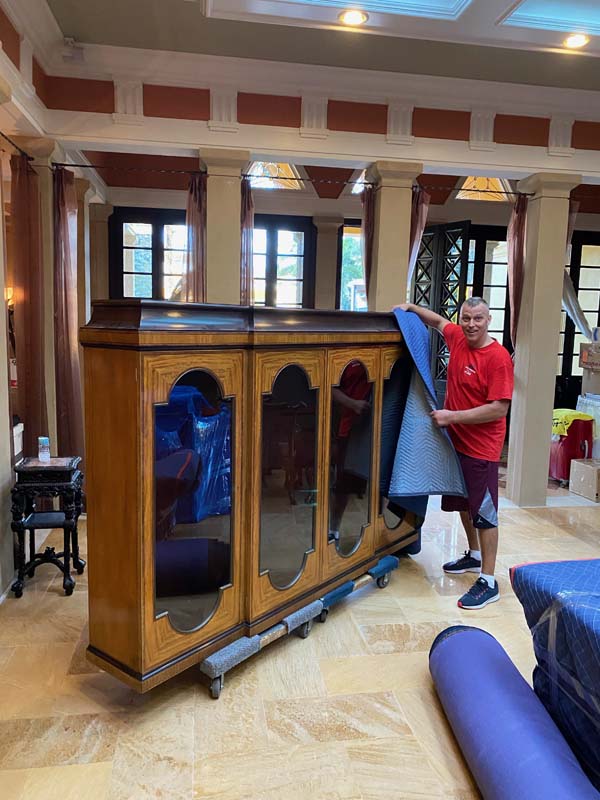
Once the inspection is done and the movers are cleared to bring items in, make sure runners are down on any hardwood, tile, or vinyl plank floors in your unit. Even if your building doesn’t require it, protecting your own floors from day one means the move-out inspection goes smoothly too. Our residential moving services include floor protection and furniture placement as standard parts of every job, so you’re not improvising that part on the fly.
Frequently Asked Questions
How far in advance should I contact my Casselberry apartment complex about move-in logistics?
Contact the leasing office at least 7 to 10 days before your move date. This gives you time to collect the COI from your moving company, submit it to the property, and confirm an elevator or loading area reservation. Waiting until 2 or 3 days out means you may not get your preferred time block, especially on a weekday at a busy complex.
What is a certificate of insurance (COI) and why does my apartment require it?
A COI is a document from your moving company’s insurance carrier confirming that the company carries active liability and property damage coverage. Apartment complexes require it to protect the building and other residents in case of accidental damage during your move. Most Casselberry complexes ask for at least $1,000,000 in general liability coverage, and the property management company is listed as an additional insured on the certificate.
How much does a typical Casselberry apartment move cost in 2026?
A local one-bedroom apartment move in the Casselberry area generally runs $350 to $550 for a two-person crew with a 3-hour minimum. A two-bedroom move with elevator access and a short drive typically comes in at $600 to $850. Costs rise if there are long carries, stair flights after the second floor, or if you’re moving during peak summer weekends.
Do I need to be present during the move-in inspection?
Yes. You should always conduct the move-in inspection yourself rather than trusting a form that was pre-filled by the property. Walk every room personally, document any pre-existing damage with timestamped photos or video, and submit your completed inspection form to the leasing office the same day. Keep a copy for your records. This is the document that will be compared to your move-out inspection when your deposit is returned.
What’s the best day of the week to schedule a Casselberry apartment move?
Tuesday or Wednesday is the best choice for most renters. Elevator and loading zone competition is lowest on mid-week days, mover availability is higher, and rates are sometimes 10 to 15 percent lower than peak Saturday pricing. If a weekday is impossible, Friday is a better backup than Saturday, since Saturday in May, June, and August is peak lease-turnover season at Casselberry apartment communities.
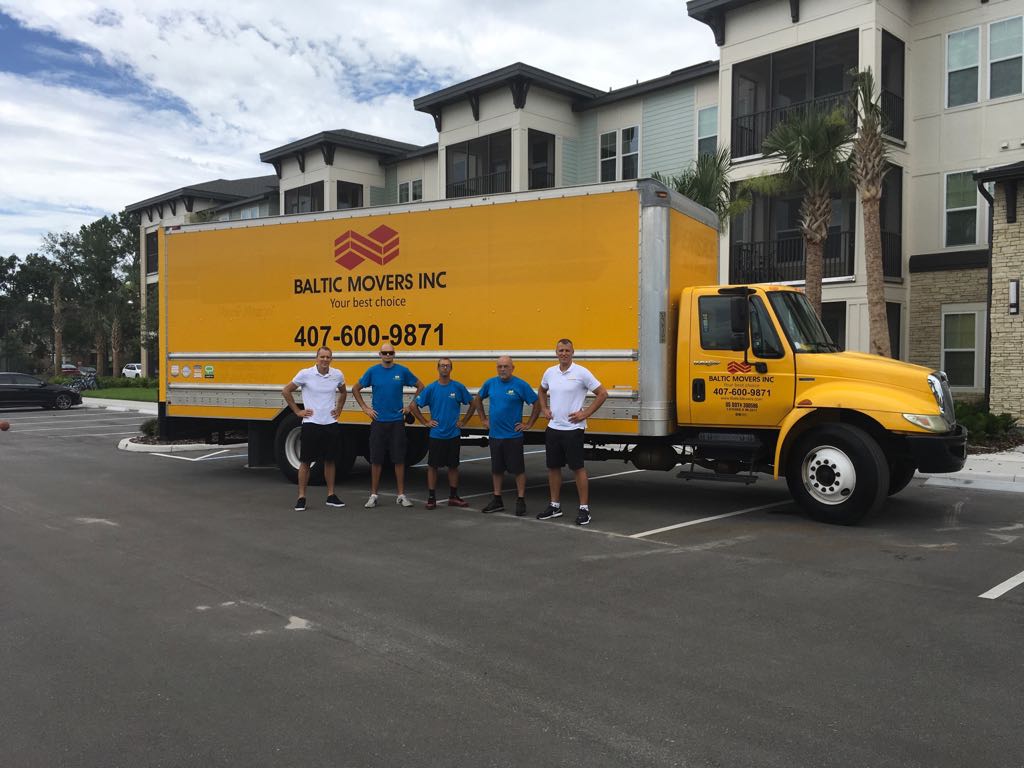
Your first Casselberry apartment move goes a lot smoother when you have a local crew that already knows the drill at the complexes along SR-436, Lake Howell Road, and 17-92, and Baltic Movers, Inc. has been handling exactly these moves since 2007.
Baltic Movers, Inc. are licensed Florida movers who handle COI paperwork, elevator coordination, and floor protection as standard. Get a free no-obligation quote today and start your first rental off stress-free.